this is one of my favorite books of art/scholarship, and if you like any of these essays i really suggest buying the actual book from Radius Books, if you can—there is so much more to it than just the writing. the physical form of the book & the pages is incredible to hold, feel, and see.
it really sucks that this important book is not available in a digital format, but i understand that the full book is hard to translate to an online version.
Like the process of physically excavating an archive, it darts in and out of images, fragments, and documents with the eye of someone undertaking a search through a body that was embalmed and cataloged years ago. In this case, it simulates what it is like to piece together a vision of an entire country and people&mdash:the Philippines, Filipinos, and by extension Filipinx Americans[1]—through the lens of the American colonial archive.
What does it mean to not see yourself clearly?
My recent work focuses on the problematic construction of American history and how photography informs deeply biased structures foregrounding whiteness as a normative subject. Borrowing from the visual language of photography, anthropology, and museum archives, I examine how these disciplines go hand-in-hand with producing and proliferating
images and documents of exclusion, generating a skewed collection that mirrors an American imagination built on white supremacy, ethnographic record, and cultural Othering. I do not make work about Filipino identity; I make work about the white gaze, and those are two totally different things.
Since 2019, I've used national archives and collections as visual source material for an investigation into the presence (or non-presence) of Filipinos and Filipinx Americans in these spaces. It's a simple query: Where are we, and what do we look like within these American archives? Where are we not? Where are we—accidentally? Where should we be?
Searching through an archive's documents and photographs to "find" evidence of one's cultural lineage and existence, it becomes clear that the American archive is not built for us, its colonial subjects. And when the archive is about us, it shows a frightening lack of clarity. If we were to take these archives as extensions of the American imagination, then that imagination is full of blind spots, holes, and fragments. We are seen, posed, and framed on the margins, or as props for a much-extended narrative of Manifest Destiny.
For a project at the Contemporary Art Museum in St. Louis in 2019, I spent weeks investigating archives at the Missouri Historical Society and the St. Louis Public Library in order to view the ethnographic photographs produced from the 1904 St. Louis World's Fair. Heralded at the time as a marvel of American progress and abundance, the Fair also featured the notorious Philippine Village-a type of ethnographic "human zoo" that actively displayed over 1200 imported Filipinos in an unfaithful recreation of ritual and cultural spectacle. This functioned to "educate" the American public on their new colonial subjects, as the Philippines had become a US colony in 1898 and would remain under American rule for almost a half century. The overwhelming amount of demeaning and racist imagery produced at the Fair circulated and became the most widely known representations of Filipinos in the American archive. These pictures are everywhere and are not countered, as they are considered a part of the historical record. They travel forward through time and keep on circulating over a hundred years later.
Now picture this: Two brown-skinned hands come together to cover a small grainy black and white photograph in such a way to block out most of a scene. Around these hands we can make out parts of the people they are covering: a group of dark-skinned men in "tribal" costume, their bare legs and feet standing next to spears, as if posed for a picture. Their faces and identifying features, however, are covered by hands-my hands-as if to keep them anonymous and protected from a public that had put them on display. It's a curious re-photo that shows and doesn't show at the same time. It withholds and denies and attempts to frustrate the viewer in the act of looking. It's one of many, many similar instances in which I physically used my hands to cover and edit the images of Filipinos put on display at the Fair. I sat in the archives and systematically intervened in their pictorial delivery system. The final work of covered photographs is called Block Out the Sun and was my way of "talking back" to the dehumanization of this archive.
Not long after, I was deep in the Archives Center at the Smithsonian National Museum of American History, having received a Smithsonian Artist Research Fellowship to do a month of study, again looking for evidence of Filipinos in a national archive. I wasn't interested in a heritage study, where I would find cultural connection with my "identity." I was attempting the opposite, which was to see how the empire sees us. Search after search turned up fragments, bits, and incomplete evidence, as if the only way we could make it in was through ethnographic photo, war document, or accidental inclusion. At one point, I found so few records outside of these spheres that I started typing in peripheral terms like "Oriental" and misspelled versions of "Philippines" and "Filipino" into the search engines. As my frustrations grew, the field of searches grew, the search terms getting wilder and more abstract in order to find something.
The Smithsonian searches took me into the business records of the Duncan Yo-Yo Company, which, strangely enough, had one of the largest collections of images of Filipinos, men who had been brought over in the 1920s and '30s as traveling salesmen to hawk yo-yos to the general public. In the Anthropology archives, I found a folder of photographs of Filipino Tasaday peoples mixed in with indigenous South American Amazonian peoples, which had somehow accidentally migrated together and become one and the same in the eyes of the archivists. There, I also found an image of Philippine national hero, author, and doctor Jose Rizal labeled simply with the generic "Portrait of Man" and handwritten on the side a quizzical "Philippines"?
The hard truth was that the empire, despite holding us for half a century, still did not recognize us. The colonial legacy of the ethnographic image was still the primary lens, along with mislabeled files, untagged records, dead ends, and fragments.
What do you do with erasure, disintegration, and obfuscation? How can we re-envision, assert, and insert ourselves when left out of the original national narrative?
One of the last photos in this book shows a black-and-white photograph of a group of Filipina women in traditional dress, dancing and joyful. It's one of the best images I could find in the Smithsonian National Museum of American History that depicts us. It's an anomaly, a blip, a beacon, a light. I was stunned when I found it; it was so different from all the other images of "us." It sits in an archival storage box, and the caption for it explains its origin: "Nationalities: Eleven Filipino women in native dress (from the American Counterpoint project, Alexander Alland, Sr., Photoprints, circa 1940, National Museum of American History, Archives Center, NMAH.AC.0204)."
The lengthy title of this artwork places it within a specific index of an American archive. You can track it back. The call numbers show the image as being officially logged into a shelf of history, a moment where these women can be called forward to attest to their presence in a sea of non-representation. If we look closer at this image, we can see that it's actually a picture of a taped-together picture-the original photograph by Alexander Alland Sr. sitting in a box on a table, was photographed by me and blown up and printed in pieces as low-resolution LaserJet prints, complete with cut edges and overhanging paper margins. These pieces were then literally Scotch-taped together into a giant poster, pinned to my studio wall, photographed yet again, and then finally printed as a high-resolution large-scale archival print and framed. It's a reproduction that has gone through multiple processes of reproduction, from low resolution to high resolution, from the belly of the archive, buried and forgotten in boxes and stacks, to a new art object.
It has also recently been acquired by the Smithsonian Museum of American Art, having migrated out of an archived box from the Smithsonian National Museum of American History, originally as a work by Alland, a documentary photographer, and retold as an artwork by me, a Filipinx American speculating on her own place within a national narrative. I see this swapping of origins and histories as a form of regeneration, a nod to the legacy of Alexander Alland, a Ukrainian-born Jewish refugee whose life's work included documenting immigrant communities in America to counter rising xenophobia. His picture, reflecting us, brought me profound light, and I, in turn, bring it to light eighty years later through reproduction, com- pressing time and distance between us. Together, we get to sit in solidarity as dual authors in a new spotlight-not hidden away.
Just yesterday, I did a search through the Smithsonian online database for the term "Filipino American," and I found myself in the archive through this new/old work, clearly labeled. It is Object Number 2022.24.1.
Note: The descriptors and caption information notated on archival documents reflect the terminology of the time, betraying colonial language and anthropological terminology, as well as inaccuracies. Rather than correct them, I leave them to show the structure of the language of the archive, and how they appeared to me. In a few cases, I include notations that complicate or attempt to draw out more context. It is an invitation.
By "talk back" I mean: How are you interrogating, borrowing from, manipulating, departing from, utilizing, changing, resuscitating, reorganizing, reinterpreting, and perhaps even speaking out or against it? What motivates you to do this work? What methods do you use? What does it feel like to work in archives? What are the unexpected pleasures or traumas that can arise from this process? What project or projects do you want to share? What archives have you mined and why? What is at stake for you?
This was the proposition I sent to nine working artists whose unruly practices I respect and admire. I've followed their research-based work for years, and their responses evidence deeply thoughtful practices that complicate, counter, and engage the question of working within archives.
Carmen Winant shares the anxious pleasures and political problematics of feminist archive excavations, while Astria Suparak argues for how historical material can speak to a more equitable vision of a future. Gelare Khoshgozaran describes a tactic of refusing the archive's power in order to push beyond it, and Jason Lazarus presents a textual poetics that lyrically reflects the process of sifting and searching. Savannah Wood shares the history of an African American newspaper birthed from familial lineage and shows how an archive made by a community for the community creates a powerful legacy. Wendy Red Star breathes story and life into Native objects and artifacts held in institutional collections, repairing connective tissues once formerly closed off, and LJ Roberts pulls ghosts from the margins of microfilm, finding queer trans kinship and fierce beauty. Finally, Minne Atairu trains AI-generative algorithms onto Benin Bronzes and the colonial archive to create visions of possibility, while Pio Abad exhumes a dictator's legacy to actively fight ongoing political erasure and amnesia in the Philippines.
Their profound contributions to this book link a wide variety of practices in and out of archives- all under an umbrella of a sense of urgency and investment--and for that, I am deeply grateful.
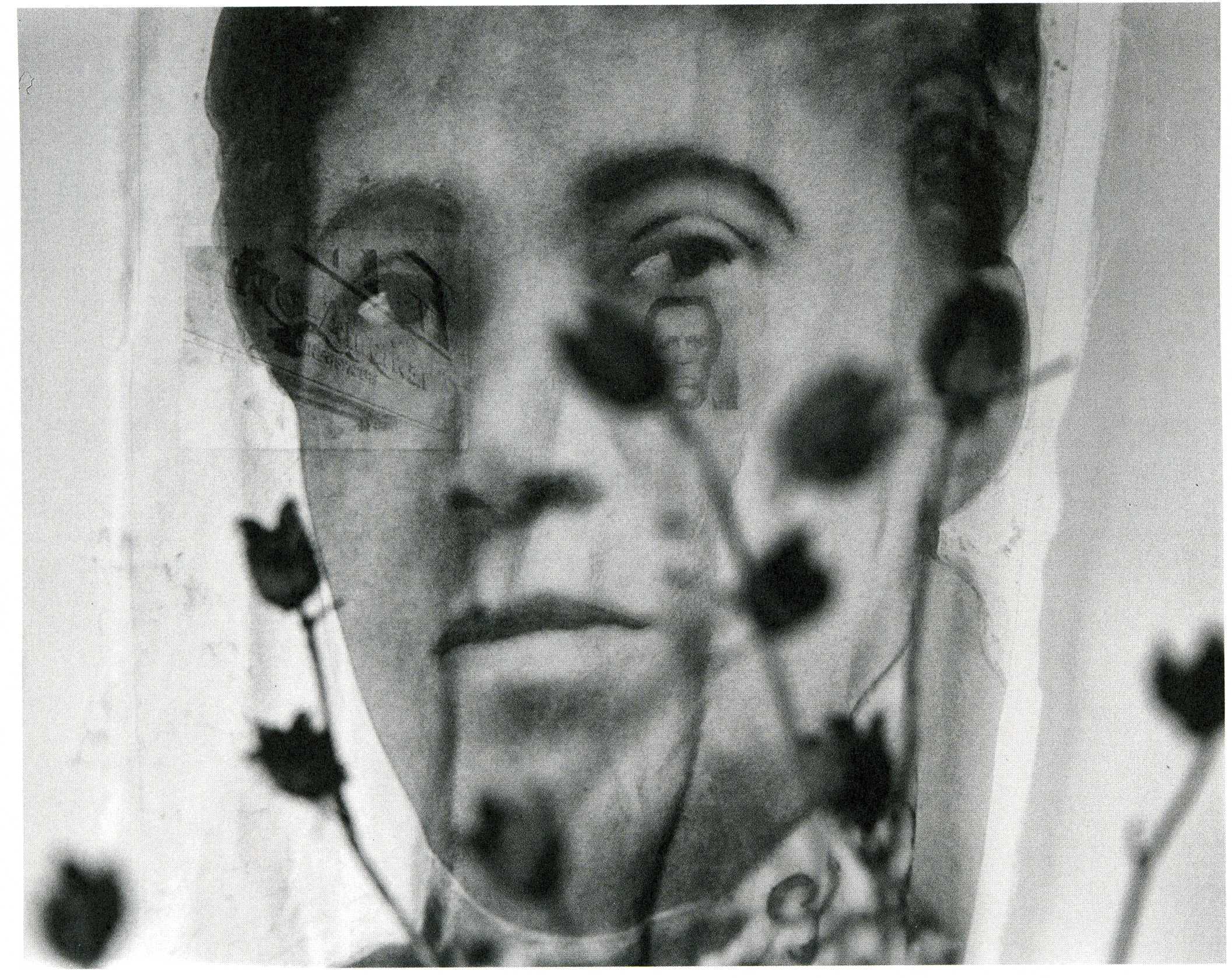
Carmen Winant's practice makes inquiry into feminist histories. With a particular interest in methods of social network building-and an emphasis on multiracial, transnational, and intergenerational exchange and inheritance-her work prompts the question: how are feminist coalitions built and what is the larger function of imagination in the process of liberation struggle? Photography operates in Winant's work as both a tool-an expository mechanism that holds an idea-and a meaningful subject. She is interested in how revolutionary social movements utilize picture-making and its dissemination in service of information sharing and alliance building.
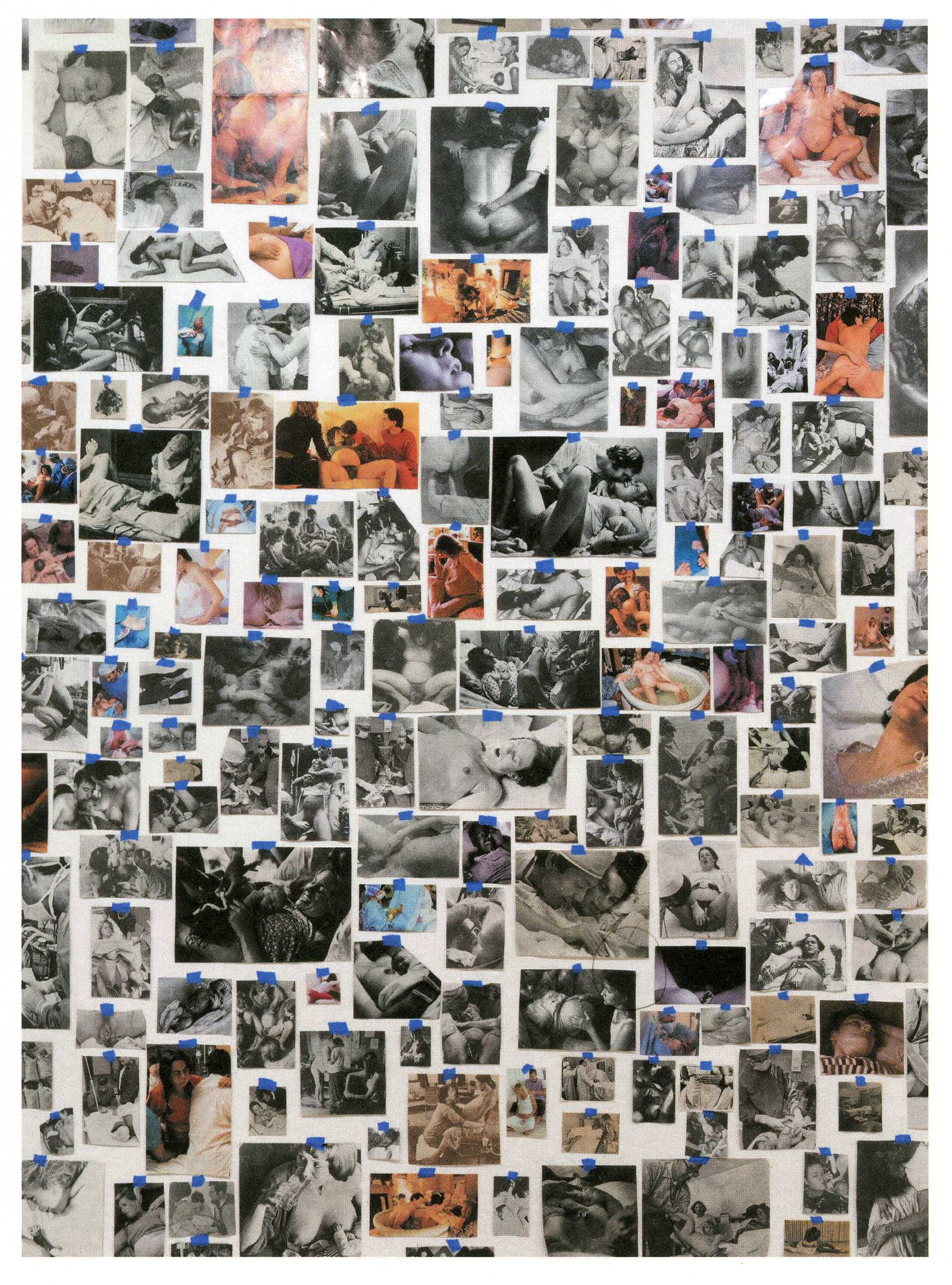
Am I an "archives artist," as I am, in fact, called? Why does the term feel so ill fitting? Perhaps it sits too uneasy with my former self, who would have found the label conservative: when I first began to work this way, I made a silent pact with myself that I would never step foot in institutions, that I would be an artist who created only "outlaw" archives (as I thought of them), assemblies of found and appropriated material that were otherwise atomized, free floating in the world. I spent months, and more often years, working to collect around a theme or experience with this method-ripping images out of books, magazines, and other printed material-not always knowing where I was headed. My most well-known work, My Birth, was made in this way, but so were many other, lesser-known projects. This felt to me to be a political, even punk, way to operate within (or without) archives, by moving around the Special Collections gatekeepers. I was to decide what would enter my collective record, and those things were almost always funky, shitty, and highly acidic photographs on paper-evidence of radical
feminist movements. Outlaw archives for outlaw histories.
As I deepened into this work, I encountered the obvious: there is no escaping the violence of archives (I also encountered the realization that such violence, and harm-making, is not metaphorical). I'd dedicated myself to outlaw archives, naively, to circumnavigate this problem, to fill in the gaps. But some holes are bottomless. Even, and perhaps especially, in assembling my own archives, the omissions in subjective experience can be so profound. I wrestled with My Birth—a project for which I was able to source only a minority of images of women of color, of surgical birth, of queer couples-as I was making it. I debated if I should show it at all, and my responsibility to not reinforce white supremacist, heteronormative value structure as it comes to making and having our babies. In the end, I did show that work. And I also spoke about these exclusions everywhere and every time I could, including on the wall label and in the one-minute audio guide. I worked, in other words, to center and vitalize that struggle as the work, not as the problem in its way, or the issue to be swept under the rug. It is an imperfect and nuanced solution, and one I am still reckoning with and evolving.
After that project, and all it revealed to me, I did begin to step into institutional spaces, if tentatively at first. I worked in university archives, historical societies, museums' papers. I did so while continuing to assemble my own catalog of found images-sometimes blending the two, not so exclusive as I once thought. And new paths have emerged (archives are like that, always opening trap doors). In the last few years, I have begun to work in close collaboration with feminist organizations and the women who run them-domestic violence advocacy and support organizations in Philadelphia and Denver, abortion clinics across the Midwest-which has been an education in trust building and reciprocity. It is a reminder for me, after all those years of working alone in the studio, that there are no social movements, and no archives of those same movements, without solidarity. Without people. And, for my part as an artist, there is no work about care work without the conditions of care. The relationships that have come from this work have been among the most meaningful of my life, and the engine for all that follows. This is the real animating force of archive work for me: in dealing with objects that belong to others, we are drawn closer.
Carmen Winant, My Birth, 2018
Found images, tape.
Installation view of Being: New Photography 2018 at The Museum of Modern Art, New York, March 18, 2018-August 19, 2018.
2018 The Museum of Modern Art. Photo: Kurt Heumiller
Astria Suparak is an artist and curator based in Oakland, California. Her cross- disciplinary projects address complex and urgent issues (like institutionalized racism, feminisms and gender, and colonialism) made accessible through a popular culture lens, such as science fiction movies, rock music, and sports. Straddling creative and scholarly work, the projects often take the form of publicly available tools and databases, chronicling subcultures and omitted perspectives.
The future brings me to the archives. Specifically, the endless depictions of an Asian future eerily drained of Asian people, as envisioned by white filmmakers. I've assembled a taxonomy[2] of the objects and tropes conscripted for these insidious stories, which drives my research into the arts, architecture, design, fashion, food, languages, and weaponry of East, Southeast, South, Central, and West Asian cultures.
My main motivation with this work is to elucidate present-day racist stereotypes and their historical antecedents. These noxious fantasies and fears, when visualized and normalized by popular culture, influence not just American society but are globally exported through the juggernaut that is the Hollywood film industry. Studying the history of anti-Asian legislation and violence—and the dehumanizing and demonizing mass media depictions that lead up to these moments-is grim and infuriating work. In (white-dominated) experimental film circles, mainstream movies and the Academy Awards are disregarded as frivolous and inconsequential, and in the art world, as low-brow and lightweight. But these omnipresent films and TV shows have real-world consequences. They spread the contrived history of an all-white Europe of yore, which fuels white supremacists and anti-immigration ordinances. And they embed the wicked myth that non-white cultures-particularly Indigenous, Brown, and Black people—are too stupid and incompetent to have invented monumental architecture and sophisticated public infrastructure, therefore making acceptable the ludicrous conspiracy theory that many of the world's greatest wonders were built by extraterrestrial aliens. This is echoed in the successful campaigns against affirmative action and DEI (diversity, equity, and inclusion) programs, and the skepticism that people of color haven't truly merited their laurels.
My second goal is to highlight lesser-known histories of Asian creativity and brilliance. This repairs two gaps: the personal, as a second-generation immigrant from a lineage of orphans, refugees, assimilators, divorcees, and abandoned and/or estranged people who can't or won't share details of our past; and the (American) cultural, primarily public education and popular culture. With Ancient Sci-Fi[3], I created backdrops of fourteenth- to twentieth-century cultural materials (including manuscripts, paintings, tapestries, furniture, and architecture) from across Asia that contain concepts central to present-day science fiction and fantasy.[4] I intentionally selected images that were public domain, copyright free, or under a Creative Commons license to ensure that the whole set could be downloaded for free and circulate more easily.
I deliberate about who and what to name and cite. Within my performance lecture Asian futures, without Asians,[5] I don't waste time verbally naming the white directors and actors or shoring up their name recognition, but I purposefully identify the Asian artists and talent, who are often relegated to brief and cartoonish appearances. I'm also pointing out and naming the specific Asian-derived clothing articles, ornaments, armaments, and artifacts-frequently used incorrectly, inappropriately, and/or under the label of another ethnicity-as well as specifying the traditions to which they belong.
Much of my current work makes connections across distinct groups for possible solidarities: Pan-Asian (not narrowed to East Asia, as that term is typically construed in the United States), the tropical zone, the Global South, and populations with shared histories of exploitation and colonialism. We will not be separated and isolated in the present or erased from the future. And archives are key to this—investigating, correcting, activating, supplementing, expanding, and reimagining the archive.
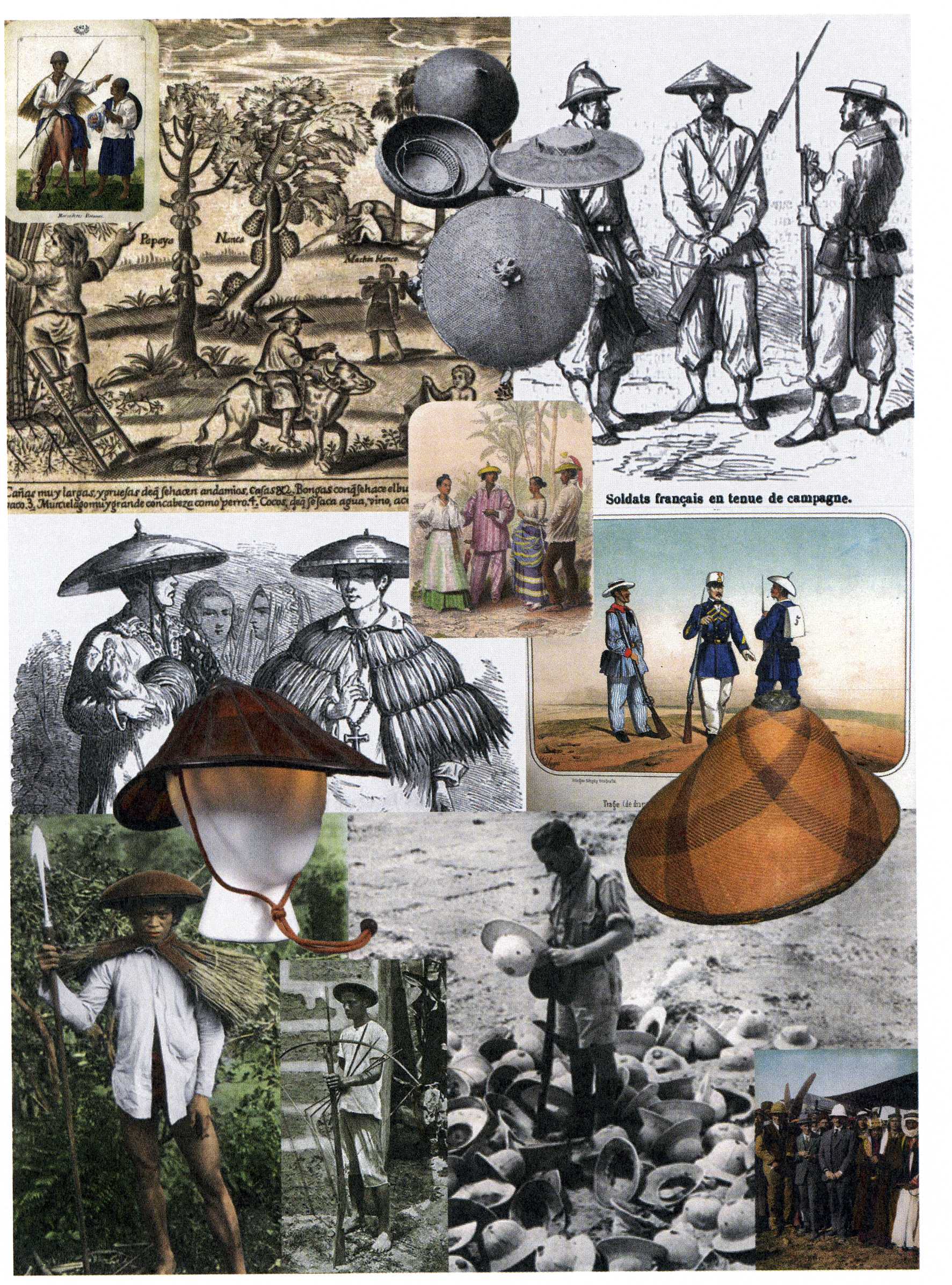
Astria Suparak & Caroline Washington, Helmet to Helmet, collage, 8 x 10 inches, 2021
Helmet to Helmet doubles as a timeline, with illustrations, photos, prints, and artifacts from the early 1700s to the twentieth-century, delineating how the Philippine salakót was worn by inhabitants of the archipelago, then adopted by occupying Spanish and French soldiers, and gradually adapted into the pith helmet made standard issue for troops around the globe.
More Poetics, Less Forensics by Gelare Khoshgozaran
Gelare Khoshgozaran is an undisciplinary artist and writer whose work engages with the legacies of imperial violence manifested in war and militarization, borders, and archives. They use film and video to explore narratives of belonging outside of the geographies and temporalities that both unsettle our sense of home and make our places of affinity uninhabitable. Khoshgozaran is an Assistant Professor of Art at UCLA School of Art and Architecture and editor at MARCH: a journal of art and strategy.
While any speech act is relational, talking back is premised on the imbalance of power in the relation. Talking back at the archive is a response to the archive as the location of power. Whether through a small gesture of protest, an intervention in the archive, or a material taking back[6], talking back at the archive is an attempt to reclaim that power. Similar to reclaiming "the right to look," it is a rebellion by enunciating a subject who "refuses to allow authority to suture its interpretation of the sensible to domination, first as law and then as the aesthetic."[7]
The histories I engage with in my practice, and I see as materially and aesthetically formative to my present time-life, are of destruction. In the wake of conflicts, wars, occupations, revolutions, even family feuds and romantic break ups, destroying the evidence of a (shared) life serves as negative proof that there never was anything worthy of preservation. Conflicts are documented and archived in what has been destroyed (lost). In my work, I've been looking for ways to open up this question, against the enclosure of archives and their logic of inclusion or exclusion, fabrication, or reconfiguration. They are always so massive that, in the end, the work becomes about them. They're seductive, and their lure is in their mythical arbitrariness as much as their material order and architecture. I often visit archives to remind myself that there is nothing there to see and that the document (evidence) has already been destroyed. The visit then becomes the main act of research, a ritual of sorts, which shifts the location of knowledge from the site of the archive to the sighting of the archive. Visiting is a way of turning the body into its own archive of experiences and emotions for me: going in and retreating, immersing and retrieving, retaining and reflecting.
This is where I'd like to propose a different approach to the question of the archive in contemporary art practice. What if our approach, as contemporary artists, is informed by the belief that there is already no power in the archive? When the institution is deprived, are the buildings and the catalogs any more than the ruins of the dispossessed—ruins to engage with not as forensic sites but as the plane for the emergence of new a poetics?
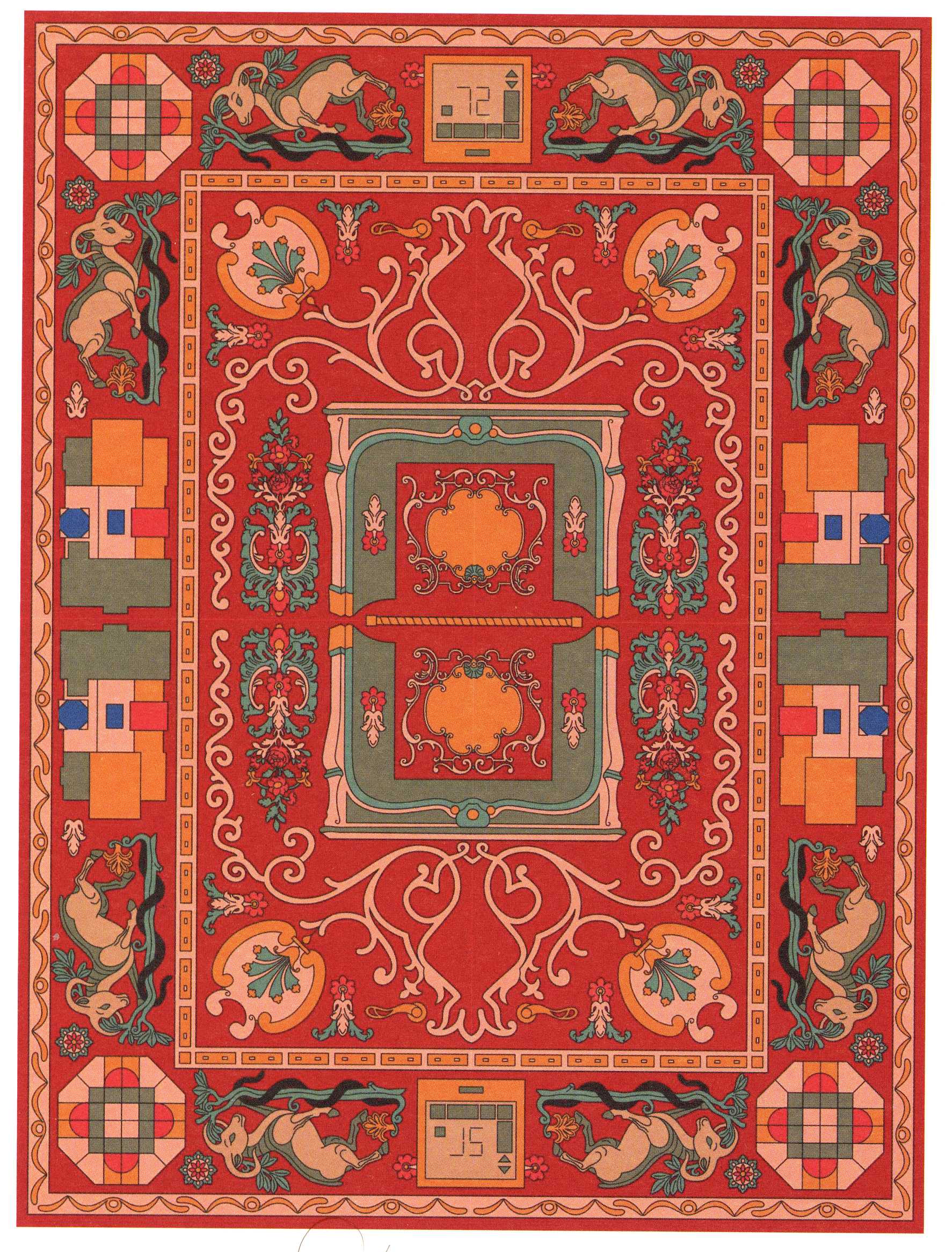
Design for "anonymous rug," 2022. The design uses interior or exterior elements from the current building of David Zwirner Gallery (former Consulate General of Iran) in New York, the architectural plan, and an animal relief that used to adorned the main door of the former Iranian Embassy in Washington, DC. The bespoke rug was produced in color, with hand tufted New Zealand wool, and is 41⁄2 x 6 feet in dimension. Concept: Gelare Khoshgozaran. Design: Sina Fakour.
Jason Lazarus is an artist exploring vision and visibility. His work includes a range of fluid methodologies: original, found and appropriated images, text-as-image, photo-derived sculptures made collaboratively with the public, live archives, LED light images, and public submission repositories, among others. This expanded photographic practice seeks new approaches of inquiry, embodiment, and bearing witness through both individual and collective research.
i never studied archives as a student, and as with a lot of things, coming in as an outsider helps and can feel liberating.
my best archive projects have started from curiosity, confusion, and vulnerability; my most rapid growth in archive-making came from a project that was built from emotional need. emotion is a north star for artists and is especially under-tapped in the making and critical reading of archives.
as emotions are messy, we encounter another lesson—organization can be the downfall of an archive, and messiness can be a strength. in some projects, after newly installing work for exhibition, i count on the images/objects in the installation being sent back to me later in new random orders that become a starting point for the next public iteration (i call this archival slippage). the altered work then asks for listening and reading anew-if i renounce control, i can feel the shock of the new.
*archive is a term and practice that needs continual renewal-it should be used and abused, challenged and reimagined. artists are uniquely situated to bend, break, and evolve their language, forms, methodologies...
with another archive, i realized that it was better to make the objects vulnerable and easily stealable, and a few were.
how can an archive embody the interior world of its maker?
when frustrated by the limits of feeling in photography, notions of framing I learned from studying photography were formative to working with archives. working beyond photographic series and into nebulous bodies of images (or image-objects) creates something that feels more oceanic.
creating basic collecting contours (like one does when composing a photograph) for a collection allows unexpected feeling and critical meaning to wayfind in and out without me having to know each step.
when my practice became more about listening, and needing to listen carefully, working with archives came more naturally.
how can an archive give more than it takes?
the temptation to correct an existing archive can sometimes be better faced by making an archive from scratch—a very subjective and idiosyncratic place that official archives may not access. on the other hand, reading official archives from a particularly subjective and idiosyncratic place can be where we find a sense of redemption.
my archive practice is always made thinking of the word in lowercase, with the hopeful emotional and intellectual effect being uppercase Archive.
i think of archives as monuments that can be fluid, transportable, searchable—gaps can define them and become meaning as well.
one thing i've learned most from making archives: i am constantly seeking the marginal and asking it to perform as the center. when i'm in official archives, i find myself staring at elements that were not meant to have critical meaning, marginalia, support structures, incidental marks, and notations.
the (orthodox) collecting logic of a genizah, a Judaic archive spanning multiple centuries, was, for me, revelatory. a genizah is anything with god's name on it, from a prayerbook to a scrap of a document, that can never be destroyed but rather is retired. it's a deep historic algorithm in which the sacred carries the profane without end (a treasure trove for researchers of all kinds). it also proves collecting logics are just one way to read archives; they can lose meaning and be subsumed over time, sometimes for the best.
my compulsion to collect is a form of love—a belief that everyday objects radiate greater possibilities of bearing witness and present/future meanings.
the most interesting thing about archives has nothing to do with archives-it's their capacity for (in)humanity.
archives are profound and violent—like any good poem, everything is at stake.
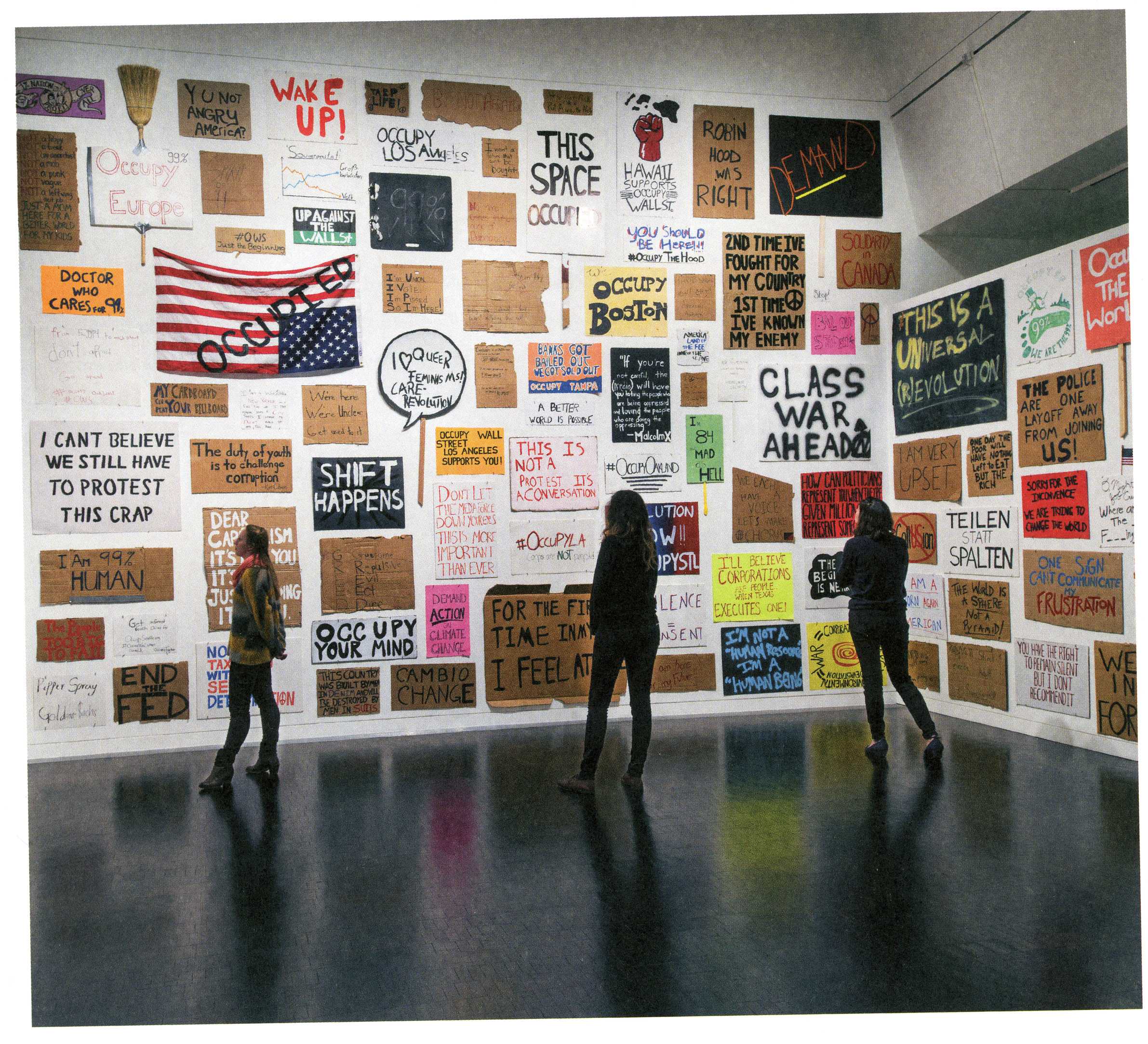
Jason Lazarus, Phase 1 Live Archive, 2011–present
Part of solo exhibition Live Archive
Contemporary Jewish Museum, San Francisco, 2013
Savannah Wood is an artist with deep roots in Baltimore and Los Angeles. Wood works primarily in photography, text, and installation to explore how spirituality, domesticity, and our relationships to place shape our identities. Her projects reconnect people with the everyday beauty of our world and the histories that lie hidden below the surface. As the Executive Director of Afro Charities, Wood is creating infrastructure to increase access to the 131-year-old AFRO American Newspapers' extensive archives.
During the past four years, I have been immersed in the AFRO American Newspapers' archives. As Executive Director of Afro Charities, I am charged with caring for the collection and making it more publicly accessible.
The AFRO has been in print since its founding in Baltimore in 1892. It is the oldest Black-owned business in Maryland and the third oldest in the United States. The archives include approximately three million photographs, several thousand letters, rare audio recordings, original political cartoons, and more than a century's worth of business records among other materials from its thirteen editions.
As a descendant of the AFRO's founders, I often find myself lingering a bit in the "Murphy" section of this collection, pulling files from the many boxes that line those shelves.
When I first moved back to Baltimore in 2019, I'd been thinking about the AFRO's origin story. As I'd been told, Martha Howard Murphy lent her husband, John Henry Murphy, $200 to buy the AFRO name and printing press at an auction. The AFRO became prosperous. Our family still owns and operates it. The end. Nuance was hard to come by, and every statement of fact led me to more questions.
Where did that initial money come from? How did Martha, a formerly enslaved Black woman, have that much disposable cash (several thousand dollars in today's money) at the turn of the twentieth century? I shelved these questions in the back of my mind, adding them to a running list of research curiosities that I would get around to when I had time.
But Martha intervened.
One afternoon, I lifted the lid of a clamshell box—an anomaly among the 1500 records boxes that form most of the collection—to find the clearest image I had yet encountered of my great-great-grandmother. There she was, tucked away in her funeral scrapbook, with a full obituary pasted next to her image.
More facts emerged. She was born enslaved in Montgomery County, MD. Her father died a wealthy farmer and philanthropist, a far cry from his early adult life as the human property of slave traffickers with prominent family names. Upon her father's death, Martha received land, which she ultimately sold to her brother, providing her with the funds to purchase the AFRO. Martha was a co-founder of Baltimore's Colored YWCA (CYWCA) and its president for nearly twenty years. Letters of condolences from fraternal organizations and Black news- papers across the country lined the remaining pages of this scrapbook, confirming just how greatly respected she was within and outside of Baltimore.
Since that fateful afternoon, I've come to recognize Martha's spirit guiding my day-to-day work.
By following the threads unspooling before me, I made my way to her place of birth-the land that also birthed the AFRO. Research into Maryland's public records revealed that the land she and her family had been enslaved on, then owned, was now owned by the State of Maryland. I reached out to Maryland's Department of Natural Resources right as they were submitting two grant proposals to restore the remaining structures on the site and to document the land's history, connecting it to the living legacy of the AFRO.
The grant proposals were successful, and work will start soon to blaze the Howard Family African American Heritage Trail, which will bring visitors into the world of Enoch George Howard and Harriet Howard—Martha's parents. Visitors will learn about our family's journey from enslavement to self-emancipation and subsequent leadership on the local and national stage for the cause of civil rights.
Through this land, I've connected with cousins near and far, who, unbeknownst to me, have been meeting for annual family reunions for the past thirty-plus years. I've started making art about this story, including a forthcoming experimental documentary that took me to Niagara Falls and Chicago, tracing our family's diaspora from this former plantation. Two cousins I interviewed spent summers on this land as late as the 1960s.
The deeper I go, the clearer Martha's image appears to me. After returning from Chicago, I found two new photographs of her, including the first I'd ever seen of her as a young woman. Soon after that, an Afro Charities board member sent me a link to an auction on eBay for a commemorative plaque carved with a relief of Martha's face that used to hang in the CYWCA building. At every turn, she shows up as if to say, "Don't forget about me."
For 131 years, the AFRO has persevered as a trusted source of news and a mirror to its community, reflecting back our struggles, joys, and everyday lives. Thousands of families are represented within this archive of Black life alongside chronicles of public civil rights battles and more than a century of world news told from Black perspectives. Every August, when we celebrate the AFRO's anniversary, I am struck by how Martha's gift of $200 has afforded us this resource. Her and her husband's investment, vision, and labor have shaped the lives of generations of people who may never know their names. Through successive generations of our family, we've built on this legacy, using the tools available to us to push this project forward.
As a steward of this archive, I am working with a small but fiercely committed team on the intensive labor of processing the collections, digitizing their photographs, and building a permanent repository and research center for the public in Baltimore.
As an artist and descendent, I'm constantly searching for the nuance in my ancestors' experiences. When I hit a wall sifting through archival records, I lean into other ways of knowing: working with ancestral astrologers and spirit mediums; traveling to relevant geographies to smell the air and see how the light falls; botanical research into the average age of walnut trees; oral histories with extended family; and anything else that might bring me closer to my ancestors' interiority. The archive serves as an entry point that can generate as many questions as it answers. Our curiosity brings these collections to life.
Wendy Red Star works across disciplines to explore the intersections of Native American ideologies and colonization, both historically and in contemporary society. Raised on the Apsáalooke (Crow) reservation in Montana, Red Star's work is informed both by her heritage and her engagement with many forms of creative expression, including photography, sculpture, video, fiber arts, and performance. An avid researcher of archives and historical narratives, Red Star seeks to incorporate and recast her research, offering new and unexpected perspectives in work that is at once inquisitive, witty, and unsettling. Intergenerational collaborative work is integral to her practice, along with creating a wider forum for the expression of Native women's voices in contemporary art.
I've always been interested, curious, a questioner who wants to know the details of the history of my community, the Apsáalooke.
One of the most powerful experiences I've had in an archive was during a Smithsonian Artist Research Fellowship at the National Museum of the American Indian (NMAI) in 2019. I had started accessing museum collections with Apsaalooke materials around 2014. Since then, I've worked in several museum collections that hold Apsáalooke cultural possessions. This Smithsonian visit was different: it was the first time that I encountered records attached to objects with names of my ancestral relatives.
There's this sense when I go through collections that have my ancestral community's possessions, of knowing the designs, the objects—I can feel intuitively that these materials are my community's. At NMAI, for the first time, the names of my second great-grandfather Bear Tail, fourth great-grandfather Green Skin, and second great-grandmother Julia Bad Boy were attached to objects and photographs that I could hold in my hands. Knowing that my ancestors once wore these accessories and interacted with them felt purposeful. For me, being in the archives is emotional work, and in being open to that emotion, in letting it guide my process, I felt, and continue to feel, like I was supposed to be doing that work, that I was meant to be there.
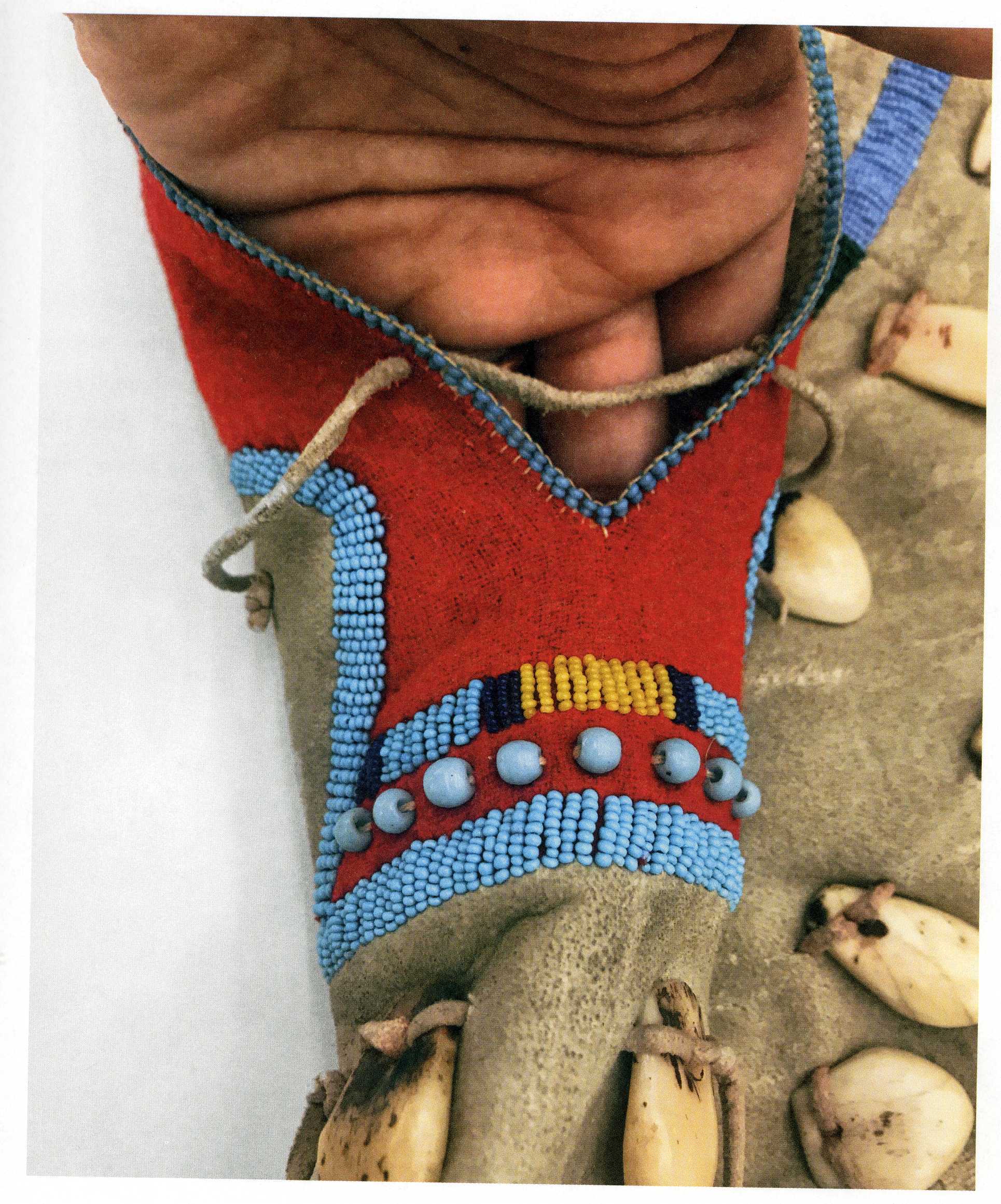
There is a beautiful buckskin elk tooth dress in the NMAI collection made by an Apsáalooke woman named Nellie Scratches Herself. When I encountered Nellie's dress in the collection, I marveled at her design choices, the subtle and delicate shifts in colors of seed beads she used to accent the arms and the yoke of the dress. I thought to myself, "This woman is a master of aesthetic." The dress was stunning: it was simple and classic in its design and neatly tailored in technique. I photographed and took measurements and ran my hands down the length of the dress looking closely at her attachment technique for the elk teeth. I looked inside the dress, and I put my hands inside so I could examine the shoulders that she adorned with pale blue pony beads that started at the yoke and continued down the tapered sleeves. Nellie even beaded the yoke's opening with powder blue beads, a technique I'd never seen before. I've seen the yoke lined with buckskin or fabric, but this was the first time I'd seen it beaded. It was delicate, it was feminine, and it struck me as very caring and thoughtful. I fell in love with the buckskin fringe that outlined the underarms and down the seams of the dress and the bottom hem.
The next day, in the photo archive, I came across a William Wildschut photograph of Nellie Scratches Herself astride a big bay horse and wearing a beautiful buckskin dress and beaded floral gauntlet gloves. Nellie was sitting tall, her legs were covered in a dazzling patterned trade blanket, and her facial expression reminded me of all Apsáalooke women and girls when getting ready to parade—you want to get it over with! She was leading another bay horse, and it looked like she was ready to go somewhere or had just returned from an event. The photograph was taken between 1917 and 1928, and the description stated: Nellie's father was Scratches His Face; her mother was Bad Buffalo Woman. She was recognized by the Indian Census as Nellie Scratches and Nellie Buffalo. Later she married Joseph J. Pickett.
I take pause and think about Nellie's dress, and I think about my experience today in my community and how community members can tell who the maker is of certain cultural items. People in the community bring their own signature to these cultural items that represent the Apsáalooke aesthetic, and they become well known for the work they make. Community members will say, "If you want a buckskin dress, you should go see Linda, or if you want a beaded belt, you should ask Lance, or Amy makes the best shawls you should go see her." I personally can point out any beadwork by James Takes Enemy or my grandmother's famous floral shawls. Nellie certainly was one of these known people in the community during her lifetime. I imagine someone saying, "Go see Nellie, she really makes good dresses." Perhaps I might run into something of Nellie's in another collection and know it is hers because of the thoughtful delicate feminine touches, that simple beaded yoke. I feel like I now know more about Nellie through her dress and photograph, and I might make that connection should I ever see another dress.
These are the moments that I cherish the most. When I find those connections in the archives, an object is no longer an object—it's full of life and personality and you see the powerful behind that object. You remember that these archives are human and they have person information to share if you take the time to notice. Seeing faces, seeing names, especially women's names, that's the good stuff, that's when I feel grateful.
One question that is asked of me is how I feel about these institutions that have my community's possessions. I'm never able to answer that question. I feel too many feelings: I feel excited to see what they have, I feel anxiety, I feel like this is my one chance to see these materials, I feel sad, I feel conflicted, but most of all I feel that I need to make the most of these visits. I can share the voices and the knowledge from these possessions kept in these vaults, on these shelves, tucked away in cabinets miles away from their origin, from their community. I can become my own archive. I can be the archive for those objects that are hard to access. I can be a resource, and I can share in my unique way of learning through my art. When I'm gone, I will become the archive for my daughter, my family, and the Apsáalooke. I will be an archive that provides access to my community, an archive that is warm not cold, an archive the speaks in collaboration with the community and the ancestors that came before.
Detail of Nellie Scratches Herself's dress, with beaded yoke detail, in the NMAI collection.
LJ Roberts is an artist and writer who creates large-scale textile installations, intricate embroideries, artist books, collages, and mixed-media sculptures. Their work illuminates oft-erased and unacknowledged queer and trans narratives, people, and places. The artist creates conceptual and geographical maps of queer life of the past, present, and future through material deviance and re-imaging craft practices.
When I go to the archive, I am looking for ghosts. I am searching for stories and figures who straddle the threshold of the (in)visible and appear in the spaces between the text. I am seeking people who move through the world unseen, appear suddenly and vividly, and then disappear again in an instant.
In 2016, in the wake of President Obama declaring the Stonewall Inn bar a national monument, The New York Times published a slew of articles regarding the event commonly referred to as Stonewall, which occurred at the site of the Stonewall Inn on the night of June 28, 1969. The Stonewall uprising was in response to frequent police brutality of queer and trans people who socialized at this (and other) New York City spaces and is credited with sparking contemporary Western gay liberation. The articles in the Times presented a singular overarching narrative of Stonewall focused on who should be credited with instigating this world-changing night or who threw the first brick. Nowhere in these articles did Stormé DeLarverie appear.
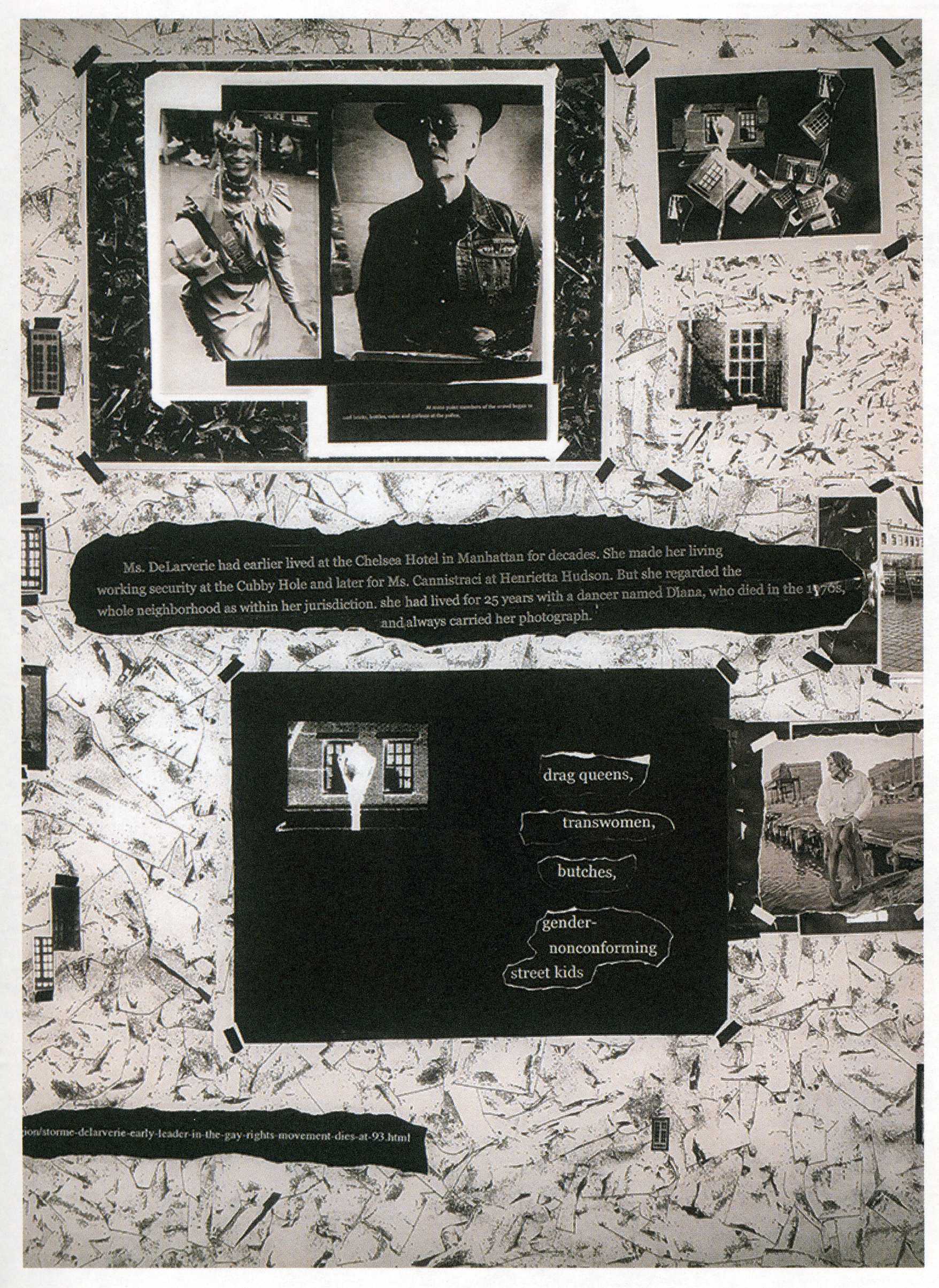
Stormé DeLarverie's role in the Stonewall rebellion was critical, and her role in queer liberation extended far beyond that night. DeLarverie was a legendary mixed-race butch lesbian drag king from Louisiana. She was a staple of The Jewel Box revue, often performing at the Apollo Theatre in Harlem; a bouncer at the landmark lesbian bars Henrietta Hudson and The Cubbyhole; and a mentor to young queer people until her death at the age of ninety-three. DeLarverie did not appear in any of these articles, even though The New York Times, only two years earlier, had published a beautiful obituary detailing her remarkable life and impact.
In the wake of The New York Times disappearing Stormé from their paper, I went looking for her ghost in the microfiche. Microfiche is ever shifting. Text and image are slowly brought into focus when the hand delicately turns the knob on the magnifier, but trying to center the words and image has been, for me, impossible, which has ultimately been more productive. I find my encounters with microfiche and the fragmented narratives they enlarge more telling of a story and how it was formed than tales that present themselves as a cohesive whole.
Deep in the microfiche archives of the New York Public Library, there was Stormé, a big grin on her handsome face, her body framed by two photographs of her past selves. I cut and spliced to reconfigure the narrative, to bring her ghost back into the room. In Stormé at Stonewall[8], these collaged texts—fragments of one article pieced with others—are printed on translucent Duratrans with neon illuminating them so that the visible intertwined with the invisible becomes the site of the story. The light boxes, choreographed to flicker via four-channel oscillator, occupy, like an apparition, the in-between space and illuminate and summon Stormé into the room.
LJ Roberts, Stormé at Stonewall [detail], 2019
Fourteen collaged light boxes and four-channel oscillator, dimensions variable. National Portrait Gallery, Smithsonian Institution; purchase funded by Tommie L. Pegues and Donald A. Capoccia, NPG.2022.11, LJ Roberts
Minne Atairu is an interdisciplinary artist and doctoral student in the Art and Art Education program at Teachers College Columbia University. Minne's research emerges at the intersection of Machine Learning, Art Education, and Hip-Hop Pedagogy. Through the use of Artificial Intelligence, Minne recombines historical fragments, sculptures, texts, images, and sounds to generate synthetic Benin Bronzes, which often hinge on questions of repatriation and post-repatriation.
What might be possible if we choose to listen to speculative, fictive, and imagined histories that attend to—who and what—colonial archives cannot historicize? In what ways can we articulate "histories that no history book can tell"? Hartman proposes an archival intervention termed Critical Fabulation. This narrative method veers from the mere recitation of historical facts to instead imagine "what might have happened or might have been said or might have been done."[9] Adopting this speculative framework, my AI-guided artistic research—Igùn—is anchored by the subjunctive question: What artifacts might have been produced during a seventeen-year (1897–1914) decline in the production of Benin Bronzes? This corpus of approximately 4,000 pillaged artifacts from the pre-colonial Benin Kingdom spans both religious and quotidian objects, including metals cast in the round and in relief, ivory carvings, wood carvings, leather works, and coral beaded jewelry.
I am particularly interested in how the colonially induced artistic recession transformed the cultural protocols governing the production and patronage of figurative bronze objects. Bronze, a material procured from communities along the West African coast and Portugal, was regulated by sumptuary laws, issued by the Oba (King)—the “sole commissioner of the arts." These laws mandated bronze casters to operate within the palace complex, thereby guaranteeing the Oba's participation in pre- and post-production rituals.
However, the 1897 British colonial invasion triggered a series of cataclysmic events, including the razing of the palace complex, the mass pillage of cultural artifacts, and the exile of the Oba, which plunged the once-thriving art scene into a recession until the restoration of the monarchy in 1914. Consequently, in the absence of an Oba whose financial sponsorship had facilitated a full-time artistic practice, Benin bronze casters were forced to migrate to satellite towns and resort to subsistence farming as a means of survival. Despite colonial intelligence reports alluding to a bustling—albeit colonially exploited—art market between 1897 and 1914, there remains a dearth of visual or archival documentation to substantiate these claims. I surmise that there was little, if any, artistic production during the seventeen-year period.
In the face of archival absence, I return to Hartman's imaginative experiment with questions: If royal authorization was a requisite, did Benin bronze casters continue to fabricate objects during the seventeen-year period? If they did continue, what forms could have been fabricated? What raw materials could have been utilized? What themes could have been explored?
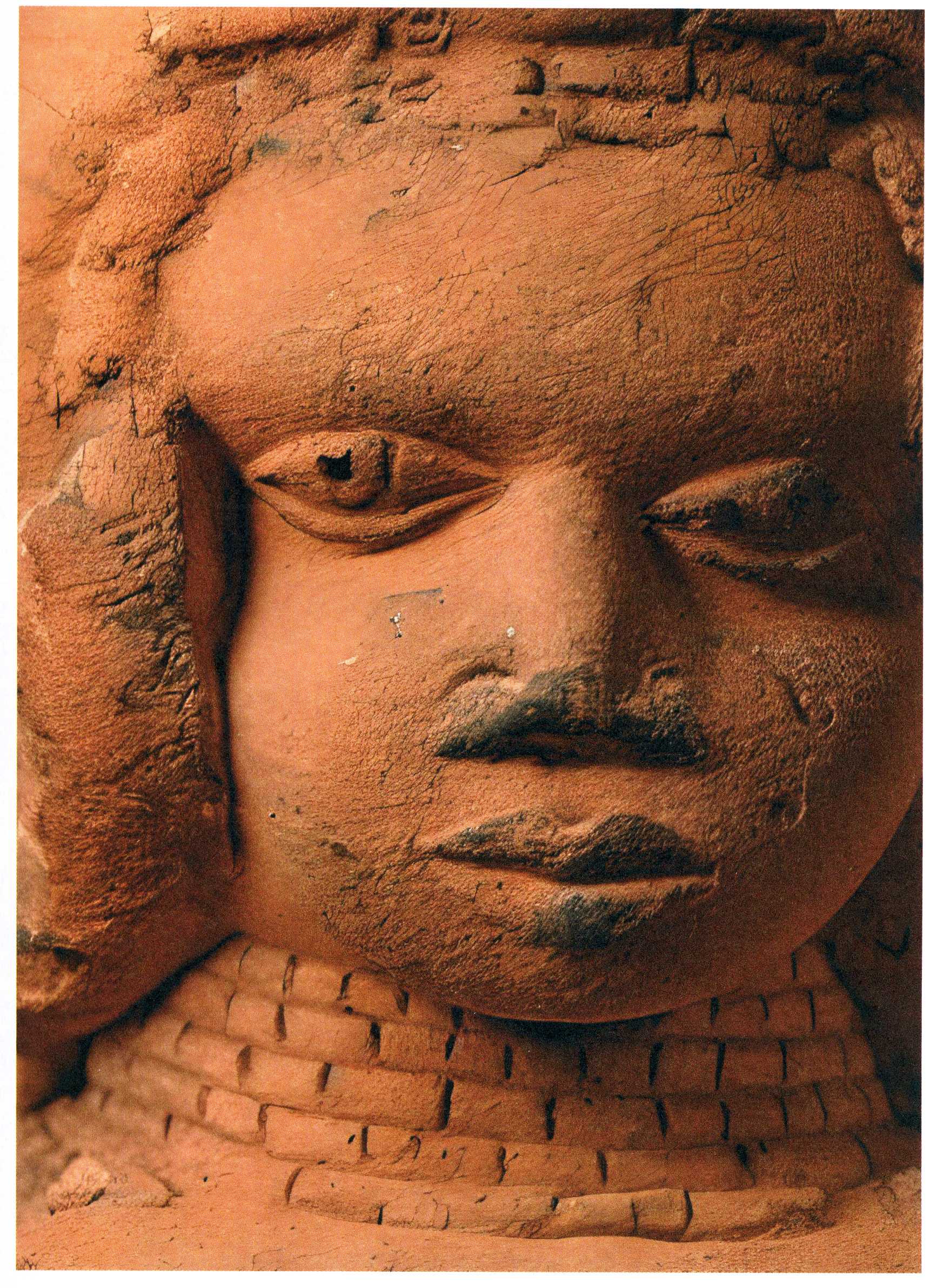
To visualize and imagine these unknown Benin Bronzes, I have trained a Generative AI model on a dataset of looted Benin Bronzes. The resulting AI-generated prototypes do not suggest any fidelity to the truth but simply point to an experiment that gives visibility to objects that could exist outside verifiable archival records.
Image of a terracotta sculpture generated using the algorithm titled Igùn Prototype VII (2023) in response to the question: What raw materials could have been utilized during the seventeen-year artistic decline?
Pio Abad's artistic practice is concerned with the personal and political entanglements of objects. His wide-ranging body of work, encompassing drawing, painting, textiles, installation, and text, mines alternative or repressed historical events and offers counternarratives that draw out threads of complicity between incidents, ideologies, and people. Deeply informed by unfolding events in the Philippines, where the artist was born and raised, his work emanates from a family narrative woven into the nation's story. Abad's parents were at the forefront of the anti-dictatorship struggle in the Philippines during the 1970s and '80s, and it is the need to remember this history that has shaped the foundations of his work.
We often think of the archive as a site for preservation where knowledge is disseminated and history is made accessible. Yet, more often than not, the archive is a place where knowledge is purposefully lost, history permanently interred.
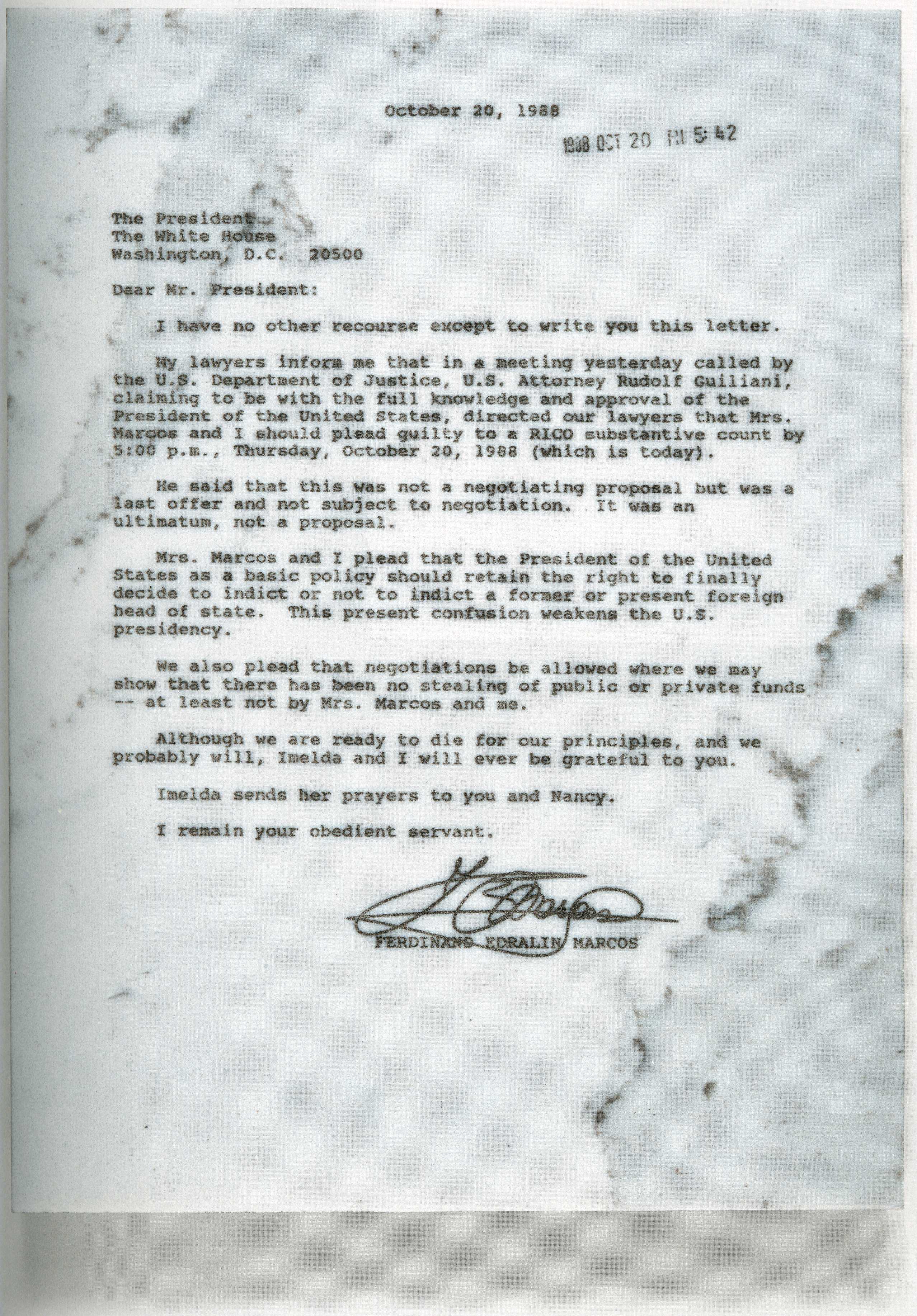
My ongoing work, Thoughtful Gifts, is one attempt at exhumation. It concerns a trove of previously unseen personal and official documents that I gathered from the Ronald Reagan presidential archives in 2019, detailing the Reagan administration's entanglements with the Philippine kleptocrats Ferdinand and Imelda Marcos. The Reagans first met the Marcoses in 1969, when Richard Nixon sent the then-governor of California and his wife Nancy to Manila to represent the United States at the opening of Imelda's pet project, the Cultural Center of the Philippines, giving the political parvenu the imprimatur of Hollywood and Washington. Seventeen years later, their friendship would culminate in President Reagan sending four US Jolly Green Giant helicopters to assist the Marcos family in absconding from Malacañang Palace moments before two million Filipinos demanding their ouster overwhelmed the palace gates.
In these works, government documents are laser engraved onto slabs of Carrara marble, the process of inscription becoming an act of implication, itemising specific moments of complicity.
Invoices and memos testify to the culture of impunity enabled by the United States: a US Air Force invoice for $183,538 details the cost of airlifting the Marcoses from Manila to their luxurious Honolulu exile; a White House memo from William Ball III, assistant to President Reagan, confirms the $858,417 spent to temporarily accommodate the exiled dictator and his family at Hickam Air Force Base; and a note from US Senator Orrin Hatch proposes that the Marcoses fund a convention center in downtown Honolulu to distract from the furious local response to the kleptocrats being coddled by their American handlers in Hawaii.
Correspondence bears witness to the close friendship between Ronald, Nancy, Imelda, and Ferdinand—a relationship forged by the couples' shared proficiency in manipulating personal myth for political gain. A letter written by Nancy to Imelda reassures the latter of the judicial processes that she can avail of under the US courts, which would eventually find her innocent of all fraud and racketeering charges. A plea from Ferdinand that Ronald intervenes with the investigation ends with the valediction, "I remain your obedient servant," undermining the rhetoric of national self-realisation that the dictator weaponised during his rule.
The gesture of inscribing these ephemera onto marble monumentalises the paper trail of empire, functioning as a symbolic recuperation of a repressed chapter in American history and a material repudiation of ongoing attempts at historical distortion.
The title of the series, Thoughtful Gifts, is itself indicative of the violence of taxonomy within the archive, a mutual by-product of lazy categorisation and wilful obfuscation. A collection of gifts from the unsavoury characters that were embraced by Reagan's realpolitik were labelled "thoughtful gifts" by the White House. This classification included a life-size American eagle statue ornamented with seashells and mother of pearl presented by the Marcoses during a controversial 1982 state visit; a kitsch folk painting from the Guatemalan president Efraín Ríos Montt depicting the very same Mayan Indians that were massacred during his regime; and an oil paint portrait of British Prime Minister Margaret Thatcher gifted to the Reagans on the proviso that it be on permanent and prominent display. Within this seemingly benign nomenclature is a nexus of individuals, communities, and ideologies that have benefited from and been annihilated by the United States's quest for geopolitical dominance and the perpetuation of its political mythologies.
Pio Abad, Thoughtful Gifts (October 20, 1988), 2020
Laser engraved etching on Carrara marble, 33 x 25 x 2 cm
Carnegie Museum of Art
INTRODUCTION: For the sake of this book, I will use the term "Filipinx" and "Filipino American" sometimes interchangeably to acknowledge the existing and, at times, generationally different usages of self-identification-Filipinx being a consciously gender-neutral term, like Latinx, that indicates specific forms of solidarity. It is, however, a specifically diasporic invention not used in the Philippines. The term "Filipino American" came into being during the 1960s along with the larger Asian American solidarity movement. I will use "Filipino" to refer to peoples in and from the Philippines who generally do not claim a diasporic identity-the majority of the people depicted in the American archives. Like all cultural groups, self-identification is complex and nuanced, and no single term encompasses us all. ↩︎
SUPARAK: These concepts include the cosmos (or outer space), eternal life (immortality), magical and mythical creatures and deities (a.k.a. extraterrestrial and synthetic life), astrology and divinations (otherwise known as predictions of the future), and the apocalypse. ↩︎
SUPARAK: Asian futures, without Asians, Astria Suparak, multimedia presentation, 60 minutes, 2021-ongoing. http://bit.ly/AFWA-presentation↩︎
KHOSHGOZARAN: Nicholas Mirzoeff, "The Right to Look," The Right to Look: A Counterhistory of Visuality (Durham: Duke University Press, 2011), 476, 477. ↩︎
ROBERTS: Author's note: Stormé at Stonewall, an installation of fourteen lightboxes, was commissioned by The Brooklyn Museum and premiered in the exhibition Nobody Promised You Tomorrow: Contemporary Art After Stonewall, 2019. The piece was acquired by the National Portrait Gallery (Washington, DC) in 2022. ↩︎
ATAIRU: Saidiya, Hartman, "Venus in Two Acts," Small Axe: A Caribbean Journal of Criticism, 2008, 12(2), 1-14. ↩︎